The Best Dinner in the World
A searing pain runs across the top of my scalp, melting behind my eyes and sinking deep into my pulsing temples as I close my laptop. I’m in the midst of finishing my second issue for a new magazine (interior design, however the hell that happened). My male brain assumes that this isn’t merely a headache. Because if the average person were to experience this degree of ache inside their head, surely, they would crumble to their knees. If this were common, how could society function? How could teachers lead a class or pilots land a plane? No, this is unprecedented. Perhaps it’s a migraine triggered by the sheer amount of copyediting I’ve done, fact-checking wallpaper patterns and sconce manufacturers with the scrutiny of a bloodhound scouring a crime scene. Maybe it’s an aneurysm that I’m bravely soldiering through. Probably both. Nevertheless, the life of a magazine editor is not for the faint of heart. I have a dinner to attend.
The invitation says 6:00 PM-10:00 PM. Dear lord. It’s at a steakhouse (“Fish & Steak,” technically, but from the look of the menu, the fish will be doing some very light lifting). I put on a light tan suit, a green tie, and a pair of parachute boots – call it “steakhouse chic.” I run some bullshit equation in my head that dictates: if I dress sharp enough, get there early enough, and say hello to the right people enthusiastically enough, surely, I can justify getting home to my fiancée by 9:00. It makes sense in my head, but the headache could be throwing off my critical analysis of professional courtesies.
I leave my apartment and walk for as long as possible through Toronto’s west side, trying to soak in as much scenery before the three-storey brick storefronts transform into towering grey skyscrapers lining Toronto’s financial district. It feels appropriate that the buildings block out the sunshine as I walk further into the city’s core. Funny, if a movie were lit the same way, I’d accuse it of being too on-the-nose. Far too quickly, I arrive at the restaurant.
The exterior walls and doors are covered in an enormous, shining gold metal coating. The sight almost burns my retinas. The gold-on-gold lettering is hard to read, but it’s unmistakable nevertheless. Everything else in the financial district has either abandoned all hope of being distinctive or stained grey by years of commuter smog. The new steakhouse is Trumpian in every sense. A happy gay couple wearing several layers of leather and suede take a video of themselves entering. It’s not quite right. They walk back outside for a second take. The shorter of the two has adopted the director’s role. “One more for safety,” he says. His partner happily obliges. I slip past both of them before the third take and enter the space.

When I enter, I’m greeted by an entire welcoming committee. They’re all young women, except for an older man who seems to be the restaurant’s general manager. He greets me with a warm handshake, telling me they’ve been so excited to hear my thoughts on the menu. He has, almost undoubtedly, no idea who I am. He then watches his staff carefully to see how they greet me, which they do all at once.
“Good evening can I take your coat sorry can I get your name sorry did you have any dietary restrictions sorry how do you spell your last name sorry do you have a bag or just the jacket oh I love your suit this tag is for your coat sorry can you spell your last name for me and oh you said no dietary restrictions right?” they all say at once. My head is pounding. “Thank you so much. Yes, just the jacket and no dietary restrictions.” I spell out my last name for them, and they check their list before telling me, “Oh, looks like we have you right here!”
I congratulate them on the opening, as if each of these 20-year-olds has an ownership stake. They excitedly say “Thank you,” perhaps convinced that they might be one perfect coat-check away from earning equity. The manager smiles as he turns his back to give a warm welcome to the gay couple behind me. They capture the handshake on-camera. One take, like total pros.
I enter the main dining room by 6:05, engulfed by a sea of journalists, influencers, PR people, and a smattering of older men in expensive, ill-fitting suits who would actually frequent the place (and the only ones who can afford it). The air is thick and heavy, the sun outside eclipsed by heavy curtains. Four waiters greet me with a selection of cocktails to start. I ask for water and am told there’s none on hand at the moment, but they’d be more than happy to ask the kitchen for some. In the meantime, they have a margarita that is “just as refreshing.” For the next hour, I cling to the fellow writers and editors on the edge of the room, wondering when dinner might begin. There’s a surprisingly talented saxophone player belting out smooth jazz, seemingly directly into my ear. It brings the headache to a crescendo, but even so, the sheer existence of live music makes the space more palatable, slightly more alive, like a pulse emanating from a brass heart.
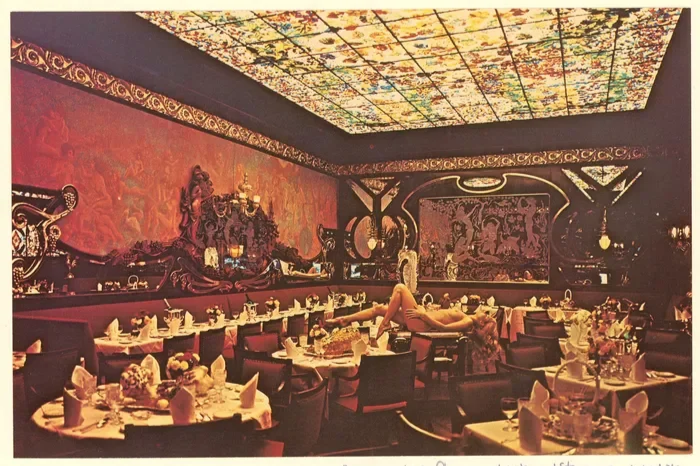
The space itself is huge, accented in gold and dark shadows painting each corner. Outside, the springtime sun is likely still shining, extending longer into the evening each day. But the inside is not bound by our earthly perceptions of time. Like a Vegas casino, the concept of day or night is washed away by glittering accents and decorative distractions. As we wait for the meal to start, editors form small cliques to talk about the industry, how media is dying, how they’re “still holding on hope,” how “everything, culturally, is a pendulum.” I heard this very script from the same people at a different dinner last month – it’s a delicate balance between blind optimism and deaf criticism that allows every writer to express a cathartic sense of nothingness. “Everything is crumbling, but also, maybe not.” I nod. The salt from my margarita glass coats my hand in a sticky mess.
“Hey, at least we get to experience this,” a veteran food editor remarks through puffy lip filler, waving her hand across the empty table, as if this were a cultural mecca reserved only for the most discerning critics. Thankfully, it’s time to sit down. Scan the rows of long tables before landing on a name nearly identical to my own, accept they’ve shoved two extra H’s in my last name to make it more phonetically pleasing. Fair enough.

In a time quite different from now, newspapers and magazines would carve out budgets for their critics to attend restaurants and productions to provide genuine insight into their quality and their position in the culture. That mostly died before I graduated from university and was replaced by budget-friendly PR invites, in which free meals at upscale restaurants are traded for a biased, vapid glossary of the evening (such pieces are often reviewed and edited by the PR teams). It’s transparent to an almost-insultingly-honest degree. The service to the public, I suppose, is twofold:
This place exists, and now you know about it.
You also know that I was on a special list, a list where my name was spelled nearly perfectly. And I knew about it before you.
I pull out a heavy dining chair and take my seat at the table, nestled between two writers I’ve never met before. The PR woman who arranged the dinner (a very friendly professional whose dinners I had avoided for far too long) comes over to greet us. She says she can’t wait for us to see the menu, and that she knew me and the writer seated to my right would get along great. I hear this at every event, like there’s some divine art to pairing different personalities together, and I am merely one thread in this beautiful tapestry of people weaved together through a meticulously crafted email blast. Oddly enough, I rarely find myself seated beside the same “type” of person (pardon my generalizations), maybe because there’s an assumption that I can get along with anyone. I prefer that thought, rather than the far more likely scenario that I’m merely seen as relentlessly inoffensive. You could put me beside the general of a child militia and I’d force some semblance of rapport. “So,” I might start, still pinning down my angle. “What made you want to start working with kids?”
The dishes begin to be served, wasting no time with subtlety. Plates land on the table featuring the precise food one would expect from a gold-plated steakhouse. Massive pretzel rolls are passed around, not with butter, but with enormous slabs of cream cheese. A man in a polo shirt and penny loafers wraps his meaty palm around one of the rolls and layers it in the thick dairy paste, like a bricklayer with wet cement. A squat waiter makes an announcement that he is going to begin preparing their “World Famous Caesar Salad.” Some of the writers at the end of the table start buzzing with anticipation. He mixes what appears to be several litres of thick dressing made moments before over a bed of romaine lettuce topped with parmigiana and croutons, explaining each step loudly, fearing we might miss a vital step when we inevitably recount the tale of the “World Famous Caesar Salad.” I ask the writer beside me who she works for, and she seems surprised that I haven’t read her work. She complains about her editor never sending her good commissions, and asks who I work for. I tell her, and she complains about my editor never sending her good commissions, that was, until she met her new editor (who, thank God, is so much better). Trying to volley the conversation back to her and relieve my pulsing brain from thinking, I ask her what got her into writing.
“Have you ever been to [club name I’ve never been to]?” she asks, seemingly out of nowhere, clearly bored (but unoffended) by my interview question. I tell her no, and that I’m not a big club person. “What’s a big club person,” she says, quizzically, “I mean, to you.”We sat there for a moment, both of us facing the wrong direction of a one-way street, bumper to bumper, nothing to say. Just then, a fleet of buttery lobsters and steaks so juicy they’d be better described as “soaking wet” lands on the table. Equally slippery vegetables arrive next to them, with cream sauces piled unavoidably on top. More bread. More cream cheese. More steak. More lobsters. A flurry of hands start grasping at dishes as the saxophone player starts up again.
Across from me, a pair of editors do their best impression of an opinion. One explains why Timothée Chalamet isn’t a good actor (“at all”), while the other says he’s great, there just haven’t been any good movies in years. “That’s why TIFF is dead,” she laments. “It’s a shame, really, because the new Nobu hotel finally gives the city a proper place to host it.”
“God, I hate NOBU,” the other retorts. He’s looking down at his phone, his thumb wandering aimlessly around the screen, prodding at the weather app. “It’s like a storage locker in there.”
“Oh, me too,” the first editor agrees, retreating hastily. Timothée Chalamet. TIFF. Nobu. All washed up. Who says criticism is dead?
I slip out to the washroom to soak my face in cold water and, before I can fully leave the table, a waiter rushes over to fold my napkin before I get back. Someone else comes to sweep crumbs off the table (maybe a waiter, but they’re wearing a different shirt and vest; it might be a breadcrumb-specialist). I go into the handicap stall (because what rules could this hedonistic garden of butter-glazed delights possibly abide by?) and sit with my head in my hands.
Somewhere, a million miles away, in another universe entirely, my fiancée is at home. She’s probably applying for an art grant, or reading a good book I’ve put off for too long, or painting in our studio. That, or walking through the nearby park, breathing in the fresh spring air. I realize the sun must be gone by now. It’s been hours. Or maybe a few minutes. I reach in my pocket to check my phone but realize I left it at the table. Is it 8:00? 9:30? I feel as though I’m trapped in a David Lynch movie. Please, don’t be after 10:00.
I return to the table and someone tells me I’ve missed an entire course. They sound a bit disappointed to me, as if I’d just slept in through a sunrise that I’d promised I’d catch with them. And yet, as I sit down, five, six, 12 dishes are piled up across the table. Creamed corn, creamed asparagus, creamy potatoes with cream cheese. More rolls.
“Sorry, what'd I miss?” I ask the group. Some of them are slipping into beef-induced comas, one refreshes an Instagram story and checks the likes. There are three.
“Oh my God, everything,” laughs the puffy-lipped editor from far down the table. “When did you leave?” The question feels rhetorical as she quickly turns to take a photo of the soggy white-coated asparagus taking center stage. The writer beside me says something sarcastic about good lighting making the food taste better. I laugh.
A total #NobuUpgrade, depending on who you ask.
Behind me, a few bartenders are setting up small bars beside each table and getting out martini glasses. The PR person is doing her rounds, listing off “soon-to-come” dessert items like a veteran waiter. “Now, this one’s known mostly for its presentation,” she says about some flambé. Usually, I prefer that good food be known for its taste. But right now, this fiery sweet treat and the flurry of bartenders passing olive-filled martini glasses to half-wasted guests offers a perfect distraction. As a collective wave, food editors and freelance writers and first dates of wealthy men in ill-fitting suits reach up for martinis like seals competing for a bucket of krill. The PR woman is delighted, taking pictures of people taking pictures of them receiving a martini.
“I’m so sorry, I have a searing headache,” I apologize. “I’m going to have to slip out.” I check my phone. 3% battery. 11:20 PM.
“So early?” she says, with a bit too much effort to sound sad. Worried I might lose whatever PR goodwill I’d restored with one fell swoop, I try to soften the landing.
“But I can’t wait until the next one!” I blurt out, completely oblivious to my own words.
“I’ll hold you to that!” she says, automatically. “I’ll have Natalie from my team email you tomorrow. We have a great wellness retreat in Prince Edward County. The soft opening is next week. Oh, trust me, you’ll love it.” As I wave goodbye to the editors at my table and stumble towards the coat check, I can’t help but feel as though I’ve just agreed to some sort of Rumplestilskin-esque bargain. But that’s to fend off next week. I hand in my gold medallion to the young woman behind the front desk and wrap myself in my trenchcoat — my Tilley suit fitting noticeably tighter — and realize I’m free.
I congratulate everyone once again on a great opening. They all say “Thank you,” proudly, while a few optimistically add “Until next time, sir.” Outside, the cold night air slaps me in the face, breathing new life into my swelling stomach. Although my mouth is parched, I’m just a few minutes away from a streetcar. I rush home and fall into the loft. I can hear Sofia typing upstairs.
“Hi!” she calls down. At night, her voice sounds like soft chimes of music. Light. Soft. A quiet symphony of calm. “How was it?”
I tell her it was gross. Horrible. Loud. Far too much. I tell her about the editors. I tell her about the gold-plated bathrooms. I tell her about the cream cheese rolls. I tell her I wish we could go out to dinner with our friends instead. Or just us, a walk in the park, or a night at the studio. Something simple. Something with people who know us. I tell her about being roped into another event next week. Somewhere in Prince Edward County. It sounds less gross, less loud, but still obligatory. She laughs. “Do you think these things are more a distraction now? To the work you like, I mean,” she asks. “I think you’re right,” I manage to admit before swallowing an Advil.
I drink an entire glass of water and put the empty cup on the table beside me. “No, you’re right,” I double-down. “What’re you writing?”
She tells me she’s working on a grant for another art residency. She’s been writing for four hours and, if I have a few minutes, she’d love it if I could read it over. Of course, I do. I tear my suit off, shower, brush my teeth, and hop into bed. By the time I start reading, a cup of ginger tea sits on my bedside table. I’ll be in the office early tomorrow, and it’s past midnight. But the night feels younger than it did an hour ago. Or clearer, at least. I can see the horizon again. Sofia is quiet as I read. Our home is quiet. The entire city is quiet. My phone screen goes from bright white to grey on my bedside table. Not totally off but even the technology is fatigued after getting beat to death all day: constantly flooded with information, so much of it utterly useless, so much of it gone by morning. For now, it lies lifelessly on the bedside table, like a small animal in hibernation. It might look dead but, inside, its heart ticks silently. “Sleep Mode,” I think it’s called.
