Running in Circles
Running: a complicated love affair (as first published for HDN Track to promote our track programming).
I ran my first and last track races entirely alone. I should note that my first track race and my last track race were the same race, but that didn’t make the experience any less isolating. I was in the fifth grade, and I had qualified for a regional 800m race at my local high school. I was granted this hallowed opportunity solely because no one else at my school wanted to run the 800m. Looking back, I don’t really think I wanted to run the distance either, but the prospect of being the only student to sign up made it feel special. I figured I’d waltz onto our local high school track like a gladiator entering the colosseum outnumbered 20-1 (in this fantasy, which replayed in my head constantly in the week leading up, I won the race in the final few strides, separating from the pack in a glorious surge).
On the day of the race, I arrived wearing high-top basketball shoes because that was the only sport I had ever really cared about until then. The shoes were from the brief and unfortunate era when Dwayne Wade signed with Converse. The soles were losing their tread, and the shoelaces were frayed. The model itself was called the Converse Wade 2s, and they weighed about 500 lbs. But when the gun sounded, gravity ceased to exist. I was flying. I was all alone.
I sprinted the first 100m, my rail-thin arms pumping without rhythm, like a chimpanzee beating senselessly against a drum set. By 200m, I had almost doubled the distance between myself and my closest opponent. By 300m, my tiny lungs began to heave (this was already far longer than the length of a basketball court). I won the first half of the race in a landslide, my legs then immediately reduced to stiff, useless logs. I was still alone as I tried to keep pushing, nearing the 500m mark, inching towards it. Then, for a brief moment, I was not alone at all. I was in the pack, strange blurred faces from nearby schools surrounding me, passing me, leaving me behind. At 600m, I was completely alone again, the rest of the pack seemingly miles ahead, although it was merely half a lap.
I looked behind me, praying to God that some other, more foolish runner from another school had tripped and fallen at some point, that I might — by some miracle — have the privilege of coming second-to-last. The crowd saw me turn around to see no one chasing me, which only made the gap feel greater.
I don’t remember who won, probably because they’d nearly wrapped up the medal ceremony by the time I ran the final 300m. I was about to write that I quit track after that race, but that isn’t quite true; I quit the moment the pack passed me. I quit the moment I realised was alone.
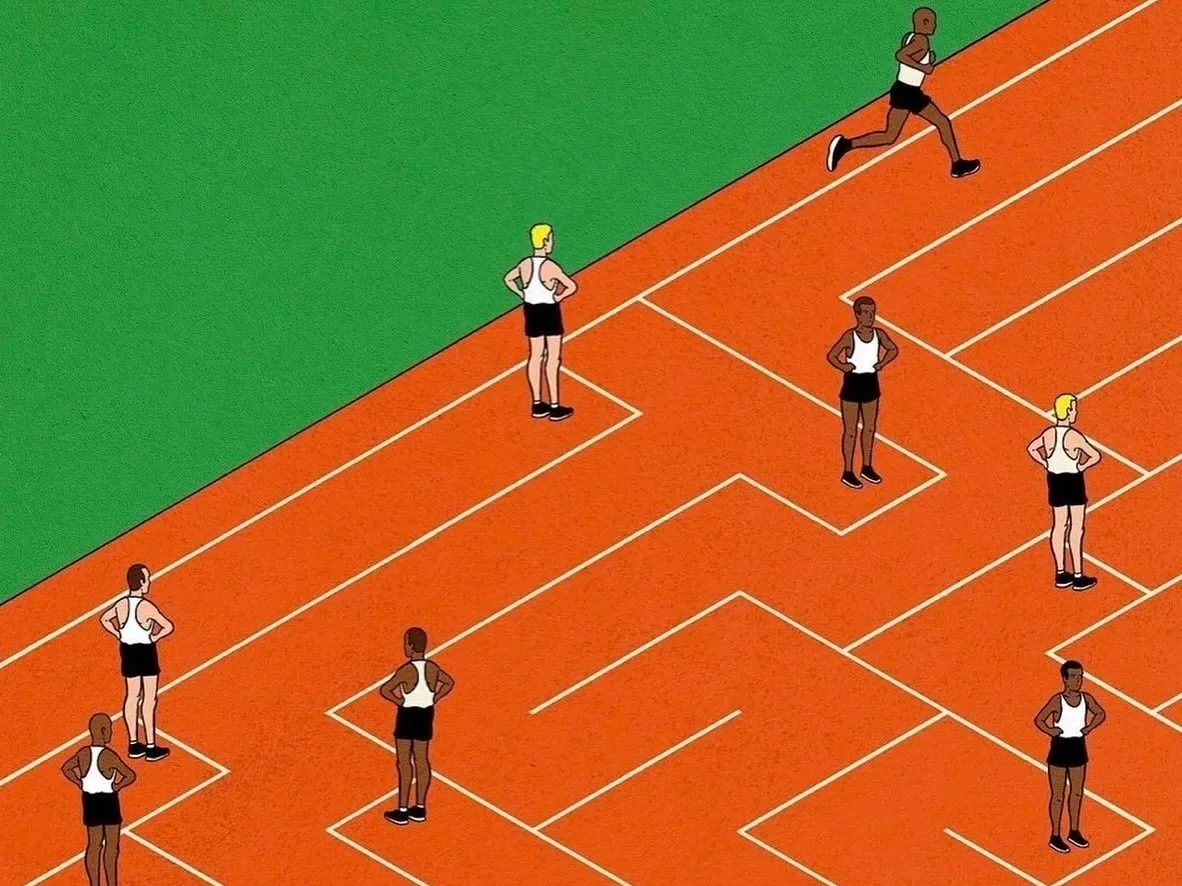
Ironically, there’s a saying in sports that the free-throw line in basketball is the loneliest place in the world. Obviously, whoever coined that phrase never came last in a track race. Running didn’t find me again until university (that’s a different story), and it really didn’t find me until I moved to Toronto and was introduced to Parkdale Roadrunners (again, that’s a different story). But it took a lot longer for me to return to the track.
When I returned a few years ago, it was because I was training quite seriously for road races. By then, I had learned that my first 100m shouldn’t be my fastest. And while tempo workouts and hill workouts and long runs were providing quick results, I also learned that nothing would sharpen my training quite like structured speed sessions on the track. If hills and long runs are the training equivalent of “eating your greens,” track sessions are the protein. That’s the most potent fuel. At least that’s what my (far faster) peers were telling me.
Now, oddly enough, track sessions are the runs I find myself rarely ever running alone. Whether it’s through Dhani, Melika, and Jack’s programming at HDN, or on the whim of a friend asking if I want to jump into their workout, it’s never a challenge to find those looking to share the work. Because that’s just what it is: shared work, a division of responsibility.
Last week, Dhani and I met at the Track for a workout. For Dhani, it was also a chance to put some finishing touches on the new (HDN Track Club program launching shortly). It was swelteringly hot and a challenging workout on the most modest of days. But it was the first week of a training block, and both of us felt fit. So, I channelled my 10-year-old self and went out faster than prescribed. Far faster. Like, way off pace. And still, I didn’t run it alone. There was Dhani, dutifully sharing my stride through 1200m. But on the track, recklessness doesn’t happen in a vacuum: when you lead a rep, you’re doing so with your team. And to mislead oneself is to mislead those who have trusted you with part of their work.
In true Dhani fashion, the wonky pace didn’t go unchecked. Like any good coach would, he reset the pace as he took the lead on the next rep. After that, I dialled it in. Then he led again, my brain and body infinitely less taxed on the reps he was spearheading, moving in autopilot, rhythmically striding in unison with those around me.
It is the loneliest place in the world, but only if you let it be. It is, as I’ve found in recent years, also one of the most poignant representations of community in running.
That morning, I was running a bit behind schedule. The heat was forecast to push past 40°, so I told Dhani he was more than welcome to start without me. “I’ll wait,” he responded immediately. “I’d rather run it in the heat than do it by myself.” Fantasies of sleeping in and doing the workout on the treadmill were extinguished. His work had become my work; my procrastination had become his procrastination.
One of the most formative books to my adult life is Flow: The Psychology of Optimal Experience by Mihaly Csikszentmihalyi. It’s a short book, so I recommend you read it, but the core thesis of the book centres around optimizing one’s growth (and flow) by balancing experiences that are challenging enough to push past one’s preconceived limits while not being so challenging that they paralyze development.
In this sense (and in a sense my fifth-grade self would have never had the patience to grapple with), track work is the ultimate manifestation of flow. We work with others to find that tight window of speed and distance that pushes our limits of fitness, without going so far as to blow up the rest of the workout. And sure, sometimes I need Dhani or Jack or Melika to pull me back and remind me that a workout isn’t won in the first 400m. Really, I’m still the 10-year-old kid in Dwayne Wade Converses who just wants to run fast. But now, I don’t run alone; never too far ahead, never dragging too far behind, simply flowing in the rhythm of collective work.
— David Stol, Creative Director, HDN Track
