What I Talk About When I Talk About Work

Photo by Chuck Fishman.
I’ve been thinking a lot about work. Not in the granular day-to-day sense (sorry, if any of my bosses are reading this – but I’m squeezing every droplet of juice out of my vacation). But work in the larger, more general sense is a concept that’s been at the front of my mind recently. Mostly, it’s because it often feels like I’ve entered a stage of adulthood where “work” has become the most popular social crutch. And I get it. Every conversation feels wrought with potential landmines, ready to explode at the first mention of politics or mutual acquaintances or the state of dating or the general sensibilities amongst 28-35-year-old guys. To avoid social speed bumps in our beer league locker rooms or double-date nights or whatever third space you’re occupying between home and the office, it’s understandable why we’ve clung to such a comfortable default. The problem is, it’s making me want to blow my brains out. Or, at least, the way in which we’re talking about work is driving me there.
I suspect a lot of people feel the same. Anecdotally, it came to mind towards the end of last month. I’d visited my hometown for the weekend before Christmas and, naturally, ended up going through the same spiel over and over. I bumped into the mom of a former elementary school classmate in the grocery store. I met up with a few friends for a run. I talked to the barista who was nosy enough to look at my laptop over my shoulder.
“How’s work going?” It’s the universal signalling of the show to start. Pick up your script. Recite your lines.
“Ohh,” I say, acting like I’m mulling over the question and not copying the same answer from an hour ago, verbatim. “Pretty good! Slowing down now. Everyone’s all logged off, so it’s all planning for the spring issue in the new year.”

Photo by Michael Brennan.
Granted, a boring question begets a boring answer. I understand that, as far as “meat on the bone,” my response is basically a decayed fossil six feet in the dirt. I’m as much apart of the problem as anyone else. In virtually every instance, the follow-up is probably meant to spark some sort of excitement.
“Who’s the best person you’ve interviewed this year?”
I mean, respectfully, huh? By now, I have conversational whiplash. Going from a generalist inquiry of “How’s work?” straight into asking for a Buzzfeed listicle of highlights feels like someone trying to parlay a meet-cute on the street into a marriage proposal. Even my most diplomatic instincts can’t bring me to placate this question. Ever. Answering would just feel so self-flagellating that I typically rush to change the subject two questions in.
It’s not that people have bad intentions. They’re trying to be friendly. And I’m just as guilty of rushing to the most accessible questions when trying to get to know a person. But I think the epidemic of what we talk about when we talk about work reflects a gravely deep issue about how we socialize: in our avoidance of conversation conflict, we’ve started valuing being palatable over being curious or interesting or intimate. And is there anything more painfully boring than palatable? No one has ever left the best meal of their life and had their instinctual reaction be, “Wow, that was super easy to digest. I think that just changed my life.” Same with conversation.

Photo by Leonard Freed.
Earlier this year, I was out to lunch with my friend Scott, SHARP’s former Art Director (and, not coincidentally, one of my favourite people to talk to). When Scott moved on from the magazine, he referred one of his close friends, Cam, for the position. Cam was a few months into the role and, being nosy, I wondered if Scott had any extra insights as to how Cam was liking it (really, I was fishing for, “He says you’re the best editor he could have ever imagined working with. He says you’re the next Harold Ross, really.”).
Instead, Scott looked surprised. “Oh, we don’t ever really talk about work.” He gave a few positive, nonchalant details (placating me, I assume), before shifting the subject. I’ve probably thought about that interaction once a week since. For these two guys to hang out that much together with a shared experience of a very intense work environment and for it not to be a constant topic of conversation whatsoever seemed quite literally impossible. What else could they be discussing? Well, from knowing both of them pretty well, I’d hazard to say: anything else.
I met up with Cam about a month ago and tried my best to mimic that same practice (no work talk – I failed, but it was a valiant effort for the first hour or so). Mostly, we talked events for community engagement and how he and Scott are building new frameworks for that in Toronto and Montreal through Mending Night (I won’t go into explaining their full ethos for Mending Night, but it’s special and you should attend). We also talked about the concept for this essay: the practice of talking about work.
In a time so wrought with obsessive comparison (it takes almost no effort to search up what everyone from your high school or university is up to and decide, in that moment, how triumphant or shitty you should feel about yourself), sometimes I feel like the discussion of work actually directs what we do for work itself. And really, how fucked up is that? What I mean is: I’ve had friends who have rejected entirely unique opportunities at a young age because it doesn’t fit the confines of traditional work. Sure, maybe it’s a leap that feels true to them. But would it make sense to describe it on a date with someone? Or the mom of a childhood friend in a grocery store?
Really, whether they realize it or not, I think most people are stunted by the idea of not having a neat, tidy answer to “So, what do you do for a living?” at a dinner party.
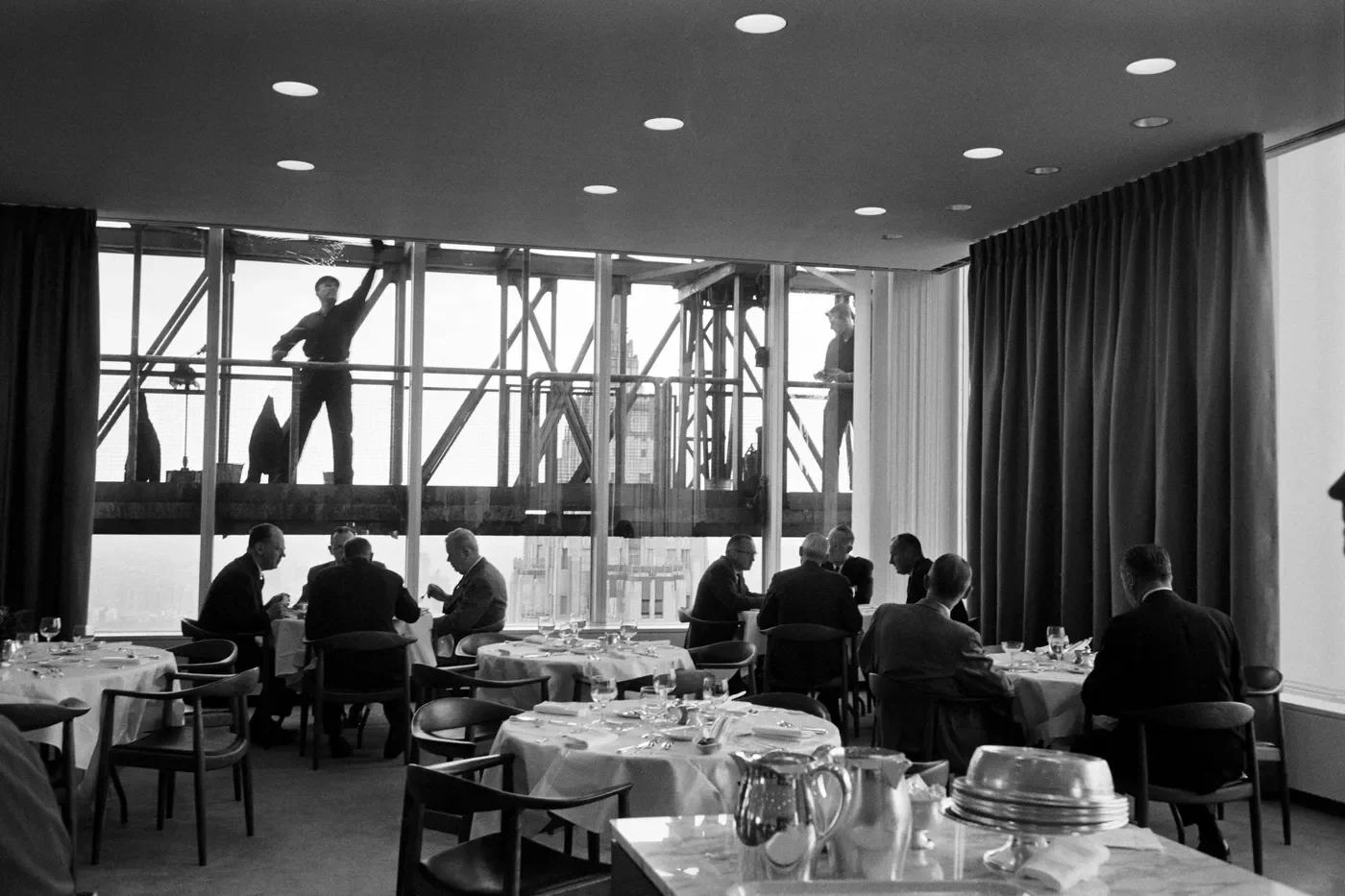
Photo by Sam Falk.
It seems to be a good sign that many of the most interesting people I know don’t jump to discussing banal office politics or boasting riveting highlights from Q3 and Q4. Last year, I unknowingly ran alongside Jackie McKeown, the Creative and Design Director for the elevated activewear brand, Literary Sport, while at a friend’s run club event. For those not “in the know,” showing up to a Toronto run club as the design lead for Literary Sport is the absolute trump card of cool jobs. I’m embarrassed to say that while I was (and am) a fan of Literary Sport, I didn’t know the face behind the brand.
And how could I?! In the 30-40 minutes we ran beside each other, I don’t think Jackie once mentioned what she did. She didn’t leverage the setting as a means of pushing product or networking. She was there for a run. I left thinking she had great thoughts on running (and great style). It wasn’t until I put the face to the (brand) name about two weeks later that I realized her job was, in fact, to have great thoughts on running (and great style).
As soon as I got home from my hometown Christmas visit last weekend, I took the streetcar to our apartment, dropped my bags off, and ran back out the door with Sofia. Two of our close friends, Michael and Kirsten, had just moved into a new apartment, so with wine and cake in hand, we made our way over to welcome them to their new home. Sofia has known the two of them since university (Michael was in her undergrad program, and she met Kirsten through him). I became friends with the two of them about three years ago and, ever since I first met them, they instantly became some of my favourite people to talk to.
Funnily enough, both of them are from my same hometown. So, soon after we arrived at their new place, we started sharing notes about our holiday visits back home. And that’s where the idea for this essay was derived: a shared distaste for the epidemic of work discourse. My oldest and closest friends, I’ve found, really don’t care about the banalities of a fashion magazine (thankfully). They care about clothing so far as it can hold up during a portage through Algonquin. They wear Coros, not Cartier. And one of the few profiles they’ve ever been remotely impressed by was on Maple Leaf William Nylander.
Again, it’s always the most interesting people who are hesitant to monologue about their day-to-day or task others with filling up space by doing the same. Of course, typically, an hour or so into seeing Michael and Kirsten, I can’t really help myself. Michael is a brilliant painter, and Kirsten is a remarkably talented nurse in downtown Toronto (they’ll hate that I wrote that) – combined with the fact that they’re hilarious storytellers, it feels like a crime not to probe for updates. But I try, just as they do, and Scott and Cam do, to make them more than a collection of trivia answers. When Scott asks about work, he usually asks about opinions of taste, most of which he’ll disagree with, but will do so without simply regurgitating points he heard on Throwing Fits last year. When Michael and Kirsten ask about work, it’s usually to paint some elaborate picture of the colourful side characters that still roam the halls of print media, not some two-bit celebrity-adjacent story without a discernable beginning, middle, or end (“I saw _____ at _____” is, in fact, not a story, regardless of how TIFF red carpet attendees try to convince us otherwise).
After all, it’d feel crazy to treat other areas of our lives with the same superficiality: “Hey man, heard you went home last weekend.. Can you list five members of your family for me?” or “Hope everything went okay with the surgery. What school did the doctor go to? Did you get his GPA? Lutheran, Presbyterian, what’s his deal?”
I’m not saying we shouldn’t talk about work. For most of us, work encompasses the majority of our time on earth (very scary thought, I’m sorry). It can be a reflection of taste or ambition or intelligence, whatever – to some degree, it’s part of who we are. It matters. I’m simply trying to elevate what I talk about when I talk about work (please, let’s also acknowledge the brilliant title of this blog – sure, kudos to Murakami for his work but let’s not let my effort at wordplay for a free blog go uncelebrated). I’ve tried to make a conscious effort to stop myself from slipping into autopilot with the same script of questions. At times, I take note of questions I’ve been asked that make me think of work from a different vantage point, or questions I’ve asked that seem to have done the same for others. If you, too, are a bit fatigued by what we talk about when we talk about work, maybe one of these can spark a good conversation. If not, no worries. I’ll keep asking politely about Q1 KPIs as our eyes glaze over and my soul screams for the sweet release of a “See you later!”
Which aspect of your personality has change most since you started your job?
At the start of each week, what excites you most about your work?
Do you think your parents understand the nuances of what you do? Who are the people that are hardest to explain it to?
What did a 12-year-old version of you hope to be? Have any aspects of that bled into what you do now?
What’s the best piece of advice you’ve received from a coworker? Have you followed it?
How do you respond to the allegations? (Keep it vague but decidedly stern – this always gets a response, guaranteed, especially when there’s no basis for asking. If you need to up the ante, you can add “And remember, this has been all on the record.”)
